Zi Wei Dou Shu: Four transformations(紫微斗數四化)
Introduction
There are only four transformations(四化星), yet they provide the dynamic element of the Zi Wei Dou Shu(紫微斗數) system. It is like adding another dimension to a flat chart. If star combinations represent the environment, the four transformations represent our thoughts and intentions. Some people turn adversity into a remarkable comeback, while others accomplish little even in favorable circumstances. The saying that a strong person does not blame their surroundings points to this inner drive.
The four transformations(四化星) do not exist independently; they attach to other stars(星曜) and modify their characteristics. Consider carbon: it can be soft as graphite or hard as diamond. As an analogy, the influence that changes how carbon behaves can be compared to a transformation.
The same star(星曜) can feel different under different transformations(四化). Its traits may become more active or reserved, more forceful or less assertive. These changes are not automatically good or bad. Softening an overly forceful star can make it less abrasive, but may also reduce its firmness and decisiveness.
There are two broad categories of four transformations(四化): those generated by time cycles(運限四化), and those generated by palace stems(宮位四化). The time-cycle category includes natal, decadal, yearly, monthly, daily, and hourly transformations, each determined by the Heavenly Stem(天干) of its corresponding cycle. Natal and decadal transformations vary by person; the other time-cycle transformations are the same for everyone at the same moment. Palace transformations are generated by each palace’s own stem(宮干).
This series of articles is original. Please indicate the source when reprinting.
Tips
My understanding of the four transformations(四化) may be imperfect. Please read critically, explore hypotheses, and verify them carefully. If you find a mistaken view in this article, you are welcome to add me on WeChat to discuss it.
A(化祿)
| five elements(五行) | Earth ⛰️ | Symbolic associations | Joy, busyness, increase, acceptance, abundance |
The prosperity transformation(化祿) is labeled A(祿) in iztro. It represents an increase: an additional gain associated with a star in a particular palace. People often take this inborn advantage for granted rather than noticing it. As a result, they may appear insensitive to hardships that others face—privilege can make another person’s difficulties hard to understand.
Many sources equate the A transformation(化祿) with money(祿存), but they work differently. Money(祿存) represents “capital” and exists as a star in its own right. The A transformation depends on another star and acts as an amplifier. For example, rebel(破軍) represents expenditure and depletion, so an A transformation on rebel(破軍) increases that expenditure. This is why some sources describe it as unfavorable. Yet increased spending can also accompany necessary investments in expanding production or a business; it is not inherently bad.
To understand the A transformation(化祿), first understand the nature of each major star(主星); only then can you see what it amplifies. For example, fortunate(天同) represents good fortune and enjoyment, and an A transformation strengthens these traits. That may sound desirable, but it can also make an already unmotivated fortunate(天同) even less inclined to strive for improvement.
An increase usually feels rewarding, so the A transformation(化祿) often brings happiness, at least in the moment. This can mean finding satisfaction even while exhausted or struggling. That is why some practitioners are cautious about an A transformation when the star combination is unfavorable: a person may willingly keep giving, only to receive nothing positive in return. That outcome can be deeply frustrating.
B(化權)
| five elements(五行) | Wood 🪵 | Symbolic associations | Possession, responsibility, execution, power, largeness |
The power transformation(化權) is labeled B(權) in iztro. It represents control, execution, and authority. Together with A(化祿) and C(化科), it forms the three auspicious transformations(三吉化). Regular readers know, however, that I do not treat anything as absolutely good or inevitably bad: taking control of something comes with a corresponding cost.
The B transformation(化權) expresses a desire for control in the area represented by its palace. In the career(官祿) palace, for example, it indicates wanting to accomplish something professionally and keep responsibility for your work in your own hands. This also suggests a sense of responsibility. Beyond responsibility, B can strengthen confidence: its palace represents an area you believe you can handle well.
The B transformation(化權) is often linked with promotion, but it does not necessarily mean a promotion; it means having more to handle. It can strengthen the ability to act, and its palace represents an area the chart owner wants to manage well. That is why it signifies responsibility.
The B transformation(化權) can also increase pressure and bring a star’s sharper traits to the fore. When it falls in another relationship palace(六親宮), it suggests a transfer of authority. Trying to control or manage the person represented by that palace can then lead to conflict.
C(化科)
| five elements(五行) | Water 🌊 | Symbolic associations | Agreeableness, social standing, benefactors, reputation, moderation |
The recognition transformation(化科) is labeled C(科) in iztro. It is often described as the star with the least negative influence in Zi Wei Dou Shu(紫微斗數), and there is a reason for this view. Its palace represents an area where the person feels most respected and proud, so they are more inclined to let others see it. This can invite envy. By “showing off,” I do not necessarily mean boasting to everyone, but an inner pride in that area of life that naturally shows through.
This palace can also provide emotional comfort when you are mentally and physically tired, which is why the C transformation(化科) is also called a benefactor star(貴人星). When you make this area visible, others become aware of it and a reputation develops. For now, we are setting aside whether that reputation is favorable or unfavorable. The central idea is becoming widely known.
We all have things we would rather keep private. If the C transformation(化科) makes such a matter visible, it is not necessarily welcome. In a relationship palace(六親宮), C usually suggests that the person represented is well-mannered and cultivated. In an activity palace(六事宮), it indicates an area where you can feel comfortable without much effort.
Comfort that comes easily can make it harder to leave your comfort zone. This is the sense of a steady, sustained flow: things proceed smoothly, with few upheavals. Traditionally, a chart was judged from its owner’s perspective, and anything demanding effort or hardship was considered unfavorable. That helped make the C transformation(化科) popular, but it is a one-sided view. Its smoothness and lack of fixation can be strengths, yet they may also reduce ambition, which is not necessarily helpful for someone seeking major achievements.
D(化忌)
| five elements(五行) | Water 🌊 | Symbolic associations | Inner conflict, attention, emotional concern, trouble, scarcity |
The obstruction transformation(化忌) is labeled D(忌) in iztro. The Chinese character 忌 combines 己 (“self”) above 心 (“heart” or “mind”), suggesting one’s inner feelings. If A(化祿) is the transformation people notice least, D is the one they feel most strongly: caring deeply can disturb our peace of mind. Traditionally, D is described as a malefic or calamity star(煞星、災星) and grouped with malefic stars under the term 煞忌, meaning malefic stars and the D transformation.
The reason is that the palace containing the D transformation(化忌) represents what matters most to the person. Whether a palace feels favorable is highly subjective. If you do not care about an area, even a poor situation there may barely affect your state of mind. In an area you care deeply about, however, you want a good situation to become even better, and even a small setback feels significant.
The palace containing D(化忌) therefore indicates where obsession is strongest; it cannot simply be labeled good or bad. D can be a source of motivation: when you feel something is missing, you look for ways to fill the gap. Just as hunger sends you in search of food, D represents that feeling of unmet need.
If transformation D(化忌) falls in a relationship palace(六親宮), the people and relationships it represents matter greatly to you, so disagreements can be deeply upsetting. In an activity palace(六事宮), it indicates attachment and a feeling that something is lacking. For example, someone with birth-year D(生年忌) in the wealth palace(財帛宮) may feel short of money or opportunities. That sense of lack can motivate persistent work and quiet wealth-building.
Tips
The four transformations(四化星) can be understood as influences resembling “energy.” Several may enter the same palace and interact, but each retains its own character. If A(化祿) and D(化忌) enter together, the joy of A and the attachment of D coexist, often making the attachment stronger. If A is like winning a lottery prize, A and D together are like winning but losing the ticket needed to claim it. Several transformations in one palace can make you especially attentive to that area and eager to manage it well.
A(化祿) and D(化忌)
This area can be a source of happiness, yet a sense that something is missing prevents you from enjoying it fully. You feel torn: it is not satisfying enough to keep as it is, but too valuable to give up.
A(化祿) and B(化權)
This area brings happiness and a desire to take charge of it. You feel a strong urge to control matters in the palace and achieve something there.
A(化祿) and C(化科)
This area brings happiness and pride, so you like to make it visible to others and feel more confident about matters related to it.
B(化權) and D(化忌)
You want control over this area but feel it is lacking. That can lead to excessive expectations and conflict.
B(化權) and C(化科)
You want control over this area and also take pride in it, making its reputation especially important to you.
C(化科) and D(化忌)
You feel this area should be a source of pride, yet notice many shortcomings, so you quietly devote effort to improving it.
When more transformations occur together, combine their individual characteristics to interpret the result; we will not go into further detail here.
Flying transformations
As explained in the introductory material, Zi Wei Dou Shu(紫微斗數) studies the relationship between people and their surroundings. Up to this section on flying transformations(飛星), we have focused on how the environment affects people’s mindset and emotions. Some are very sensitive to changes around them; others are less sensitive or simply care less about those influences.
This section concerns a person’s thoughts and feelings, which are largely subjective. For example, earning one million yuan (CNY) in a year may seem substantial to most people, yet someone who previously earned two million yuan a year may consider it a poor financial year. The comparison is with that person’s own past experience, not a universal standard.
Here, A, B, and C name palaces; they do not refer to iztro’s transformation labels. In flying transformations(飛星), the palace stem(宮干) of palace A causes a transformation on a star in palace B. This is described as A sending that transformation to B. If the transformation in B is D(化忌), it also opposes palace C, the palace opposite B. We can then say that A’s D(化忌) opposes C, as illustrated below.
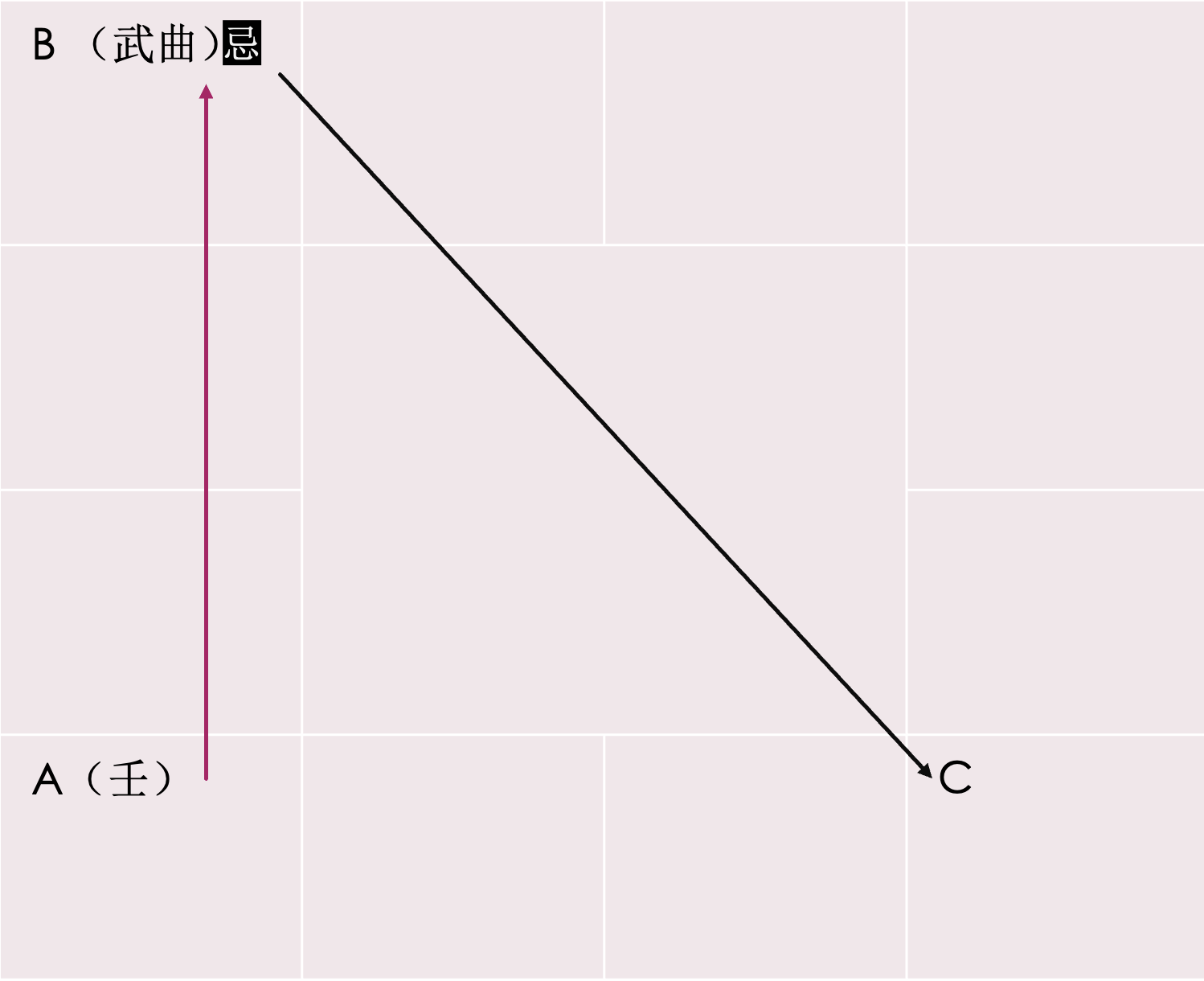
Below are the principles of flying transformations(飛星). Applying them to an interpretation requires careful thought:
Palace A sends an A transformation(化祿) into palace B
The A transformation(化祿) represents increase, so palace A can be understood as adding to palace B’s energy. In simpler terms, A “likes” B, B is a source of happiness for A, or B satisfies A.
Palace A sends a B transformation(化權) into palace B
Transformation B(化權) represents control and responsibility. A may entrust authority or greater responsibility to B, or depend on B. Distinguish whether B represents a person or an activity. If it represents an activity, A wants to control that area and must therefore assume more responsibility and invest more effort in it.
Palace A sends a C transformation(化科) into palace B
The C transformation(化科) represents help from others and reputation. Palace A therefore sees B as a source of pride or respect and tends to show others B’s qualities. Extending the idea of a benefactor(貴人), A also sees B as an area that can help ease its worries and solve its problems.
Palace A sends a D transformation(化忌) into palace B
D(化忌) represents attachment and worry. A may see B as a source of concern, or create an attachment in B. Put simply, A is preoccupied with B. A D transformation entering B also creates an
opposing aspect(衝) with B’s opposite palace, C. This aspect carries a sense of separation or parting, so in this interpretation C is the underlying source of A’s worries.Self-transformation in palace A(自化)
Self-transformation(自化) describes a subjective feeling rather than necessarily an objective situation, which can make it difficult to overcome. Self-transformation A(自化祿) feels that the palace already has enough resources and may take them for granted. Self-transformation B(自化權) feels a responsibility or a need for more control and invests more effort. Self-transformation C(自化科) may suggest self-admiration, while self-transformation D(自化忌) suggests creating worries for oneself.
Note
Palace-stem transformations(宮干飛化) concern the chart owner, so their results must be viewed from that person’s perspective. Something others see as positive may still be a source of worry for the individual. Understanding flying transformations(飛星) can help reveal the gap between inner feelings and external circumstances, support emotional adjustment, and inform decisions. When partners misunderstand each other, considering the other person’s flying transformations may help resolve the misunderstanding more quickly. However, it can also create new misunderstandings, so use this approach carefully.
Four transformations for the ten Heavenly Stems
The four-transformations(四化) tables for the Heavenly Stems(天干) differ slightly between schools. My open-source library follows The Complete Book of Zi Wei Dou Shu(紫微斗數全書), attributed to Chen Xiyi(陳希夷), so only that table is included here. I am unfamiliar with the tables of other schools and have no experience using them; please explore those independently. If you have another school’s table and its source and would like it added to the documentation, please contact me.
| Heavenly Stem(天干) | A(祿) | B(權) | C(科) | D(忌) |
|---|---|---|---|---|
| jia(甲) | judge(廉貞) | rebel(破軍) | warrior(武曲) | sun(太陽) |
| yi(乙) | advisor(天機) | sage(天梁) | emperor(紫微) | moon(太陰) |
| bing(丙) | fortunate(天同) | advisor(天機) | scholar(文昌) | judge(廉貞) |
| ding(丁) | moon(太陰) | fortunate(天同) | advisor(天機) | advocator(巨門) |
| wu(戊) | wolf(貪狼) | moon(太陰) | helper(右弼) | advisor(天機) |
| ji(己) | warrior(武曲) | wolf(貪狼) | sage(天梁) | artist(文曲) |
| geng(庚) | sun(太陽) | warrior(武曲) | moon(太陰) | fortunate(天同) |
| xin(辛) | advocator(巨門) | sun(太陽) | artist(文曲) | scholar(文昌) |
| ren(壬) | sage(天梁) | emperor(紫微) | officer(左輔) | warrior(武曲) |
| gui(癸) | rebel(破軍) | advocator(巨門) | moon(太陰) | wolf(貪狼) |