Zi Wei Dou Shu: Chart(紫微斗數星盤)
Introduction
In Zi Wei Dou Shu(紫微斗數), a chart(星盤), also called a natal chart(命盤), is a chart calculated from a person’s birth date and time. It shows the distribution of palaces(宮位) and stars(星曜). There are three chart layers: the natal chart(本命盤), decadal chart(大限盤), and annual chart(流年盤). To examine fortune over time, these three layers are overlaid and analyzed together. If you are new to Zi Wei Dou Shu, first read Basic concepts to become familiar with the terminology used here.
This series of articles is original. Please indicate the source when reprinting.
How to create a chart
The inputs needed to generate a chart are simple: the birth date, hour, and gender. Following the star placement rules(安星訣), these inputs produce a complete chart in forty-nine steps. If you only want to do chart interpretation, however, you do not need to know how to calculate a chart or memorize the placement rules.
A completed chart(星盤) looks roughly like this:

You may recognize individual labels in the chart without understanding what they mean together. Do not worry: as you work through the material on this site, the picture will become clearer. Let us now explain the chart’s contents.
Understanding the chart(星盤)
The twelve small boxes around the outside are the twelve life-area palaces(十二人事宮), or twelve palaces(十二宮) for short. The large central box is the central palace(中宮). It usually contains basic information, but you can place any information there. The red arrow-like diagram in the center marks the trine and opposite palaces(三方四正). Its tip points to the soul(命宮); its tail lies in that palace’s opposite position(四正位); and its two side tips point to the trine positions(三方位). See The palace system for a detailed explanation.
The twelve surrounding palaces(十二宮) contain different data but share the same layout. We will use one palace as an example to explain its contents.
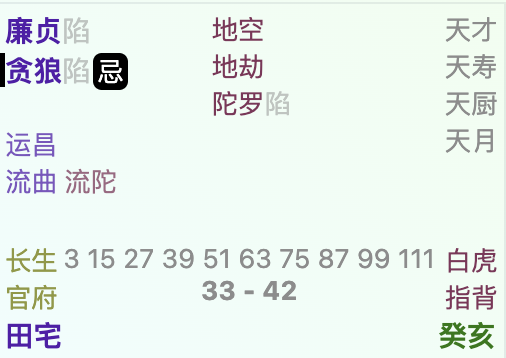
The image shows the following information:
major stars(主星)judge(廉貞) andwolf(貪狼) in the upper left corner of the picture are the major stars(主星), and the label[-3](陷) beside each one indicates its brightness.auxiliary stars(輔星)The
ideologue(地空),fickle(地劫), andtangled(陀羅) at the upper center of the image are auxiliary stars(輔星). As with major stars,[-3](陷) indicates a star’s brightness. Not every star has abrightnesslabel. See Stars in Zi Wei Dou Shu for more on brightness.miscellaneous stars(雜曜)gifted(天才),ageless(天壽),gourmet(天廚) andsickly(天月) in the upper right corner of the picture are miscellaneous stars(雜曜).transit stars(流曜)artist(Y)(流曲) andtangled(Y)(流陀) in the middle left of the image are transit stars(流曜).symbolic stars(神煞)In the picture,
born(長生)government(官府) shown in small characters in the lower left corner andsinister(白虎)insidious(指背) shown in small characters in the lower right corner are called symbolic stars(神煞), which are divided into:born(長生), one of the twelve growth-stage stars(長生十二神)government(官府), one of the twelve Doctor-cycle stars(博士十二神)insidious(指背), one of the twelve yearly General-front stars(流年將前十二神)sinister(白虎), one of the twelve yearly Year-front stars(流年歲前十二神)
age(小限)The numbers
3 15 27 39 51 63 75 87 99 111at the bottom of the image indicate theage(小限) cycle. They are expressed asnominal age(虛歲): at ages 3, 15, 27, and so on, theage(小限) cycle occupies this palace.decadal(大限)The bold range
33 - 42at the bottom of the image marks thedecadal(大限) cycle. It means that from nominal age33 years oldthrough42 years old, thedecadal(大限) cycle occupies this palace for ten years.palace nameThe
property(田宅) label in the lower left of the image is this palace’spalace name.Heavenly Stems and Earthly Branches(干支)The
gui-hai(癸亥) in the lower right of the image is this palace’sHeavenly Stems and Earthly Branches(干支) pair. Itsgui(癸) component is thepalace stem(宮干). In discussion, this palace can also be called thehai palace(亥宮).four transformations(四化)The
D(忌) after wolf(貪狼) marks one of the four transformations(四化星), specifically the birth-year D transformation(生年忌). Red indicates A(化祿), blue B(化權), green C(化科), and black D(化忌). The small black block before wolf marksself-transformation(自化) and uses the same color scheme. Here it means wolf undergoes a D self-transformation(自化忌).
How to interpret a chart
A chart(星盤) contains so much information that beginners may feel overwhelmed and unsure where to start. This is a common obstacle when learning Zi Wei Dou Shu(紫微斗數). This section gives you a sequence for interpreting a chart, helping you build familiarity step by step until you can grasp its broad outlines at a glance.
Tips
Each school has its own chart-reading methods and techniques. This site presents research and collected insights on Zi Wei Dou Shu(紫微斗數) without dividing the material by school. The aim is to make it easier to understand and enjoy the subject.
Find the soul palace(命宮)
Locating the
soul(命宮) palace is the first step in reading a chart. It is as basic as knowing where your mouth is before you eat.Examine the major stars(主星)
The
major stars(主星) in the soul palace(命宮) are the chart owner’smajor stars(主星). When people say “I amemperor(紫微)” or “she iswolf(貪狼),” they mean the major stars in that palace. Anempty palace(空宮) has no major stars, so we use those in theopposite palace(對宮) to interpret it. If these terms are unfamiliar, see the terminology explanations. Once you have identified the major stars, their traits provide a starting point for analyzing the chart owner’s personality. See The fourteen major stars for their individual characteristics.Examine the trine and opposite palaces(三方四正)
For the
soul(命宮) palace, the other palaces in itstrine and opposite palaces(三方四正) group are thesurface(遷移),career(官祿), andwealth(財帛) palaces. Their importance to a person’s life should be readily apparent, which is why traditional Zi Wei Dou Shu(紫微斗數) interpretation gives this group considerable weight. Yet a chart also needsbalance: what limits your potential is often theweakest point, rather than a single exceptionally strong palace. See The palace system for the meaning and role of each palace.Examine the spirit palace(福德宮)
The spirit palace(福德宮) reflects a person’s
psychological aspect, including preferences and thinking patterns. Considering both thetrine and opposite palaces(三方四正) and thespirit(福德) palace lets you outline their general personality and behavior.Examine the birth-year four transformations(生年四化)
The four transformations(四化星) affect the chart owner’s
inner feelings. A palace withA(祿) is associated withhappiness; one withB(權) prompts a desire forcontrol. A palace withC(科) givesa sense of being respected, so its themes are things the person likes toshow. In contrast,D(忌) marks a palace associated withinner conflictor embarrassment: the person may be reluctant toshowordiscussthat part of life, which can be a source of aninferiority complexora lack of confidence. These are the chart owner’s subjective feelings; other people may see the same matters differently. See The four transformations for details.Examine palace-stem transformations(宮干四化)
Besides the Heavenly Stems of
horoscope periods(運限) and thenatal chart(本命), each palace'spalace stem(宮干) also producesfour transformations(四化). These transformations reveal how palaces interact and relate to one another. They can help examine questions such asHow am I getting along with my partner?andHow is my job?.Analyze the palace of interest(目標宮位)
The target palace is whichever palace represents a matter of particular interest to the chart owner. Examine the
stars(星曜) in that palace and thefour transformations(四化) generated by its palace stem(宮干) to assess how that area affects the person.Examine the time cycles(運限)
The previous steps analyze the chart owner’s
static information. They provide an outline, like a preliminary sketch showing where each part of a painting will go and how large it will be. Time-cycle(運限) analysis then fills in that outline, layer by layer. It describes how the environment affects the person over time, with different cycles covering different scopes and producing different effects. See Time cycles in Zi Wei Dou Shu for details.